

Pioneer of Korean Female Education
Missionary Lulu E. Frey's Letters from Ewha Haktang, 1893–1918
The American who opened women's higher education in Korea
Lulu E. Frey served in Korea for the Woman's Foreign Missionary Society of the Methodist Episcopal Church beginning in 1893. She became a teacher and later principal at Ewha, the country's first girls' school. There, Christian principles were taught along with academic subjects, hygiene, and the sanctity of the woman-centered domestic sphere. The precepts of evangelical Christianity merged with seemingly liberating ideals of modernity. In 1910, the year Japan officially annexed Korea, Frey established Ewha's college program. Many of the young women who studied at Ewha became the first female teachers, nurses, and doctors in Korea and joined a rising cohort of "New Women" across East Asia.
These previously unpublished letters offer intimate insight into the work of running, expanding, and raising funds for a school during the political turmoil and wars that marked the end of the Joseon Dynasty, the short-lived Korean Empire, and the first decade of Japanese occupation.
A joint publication from the University of South Carolina Press and the National Taiwan University Press.
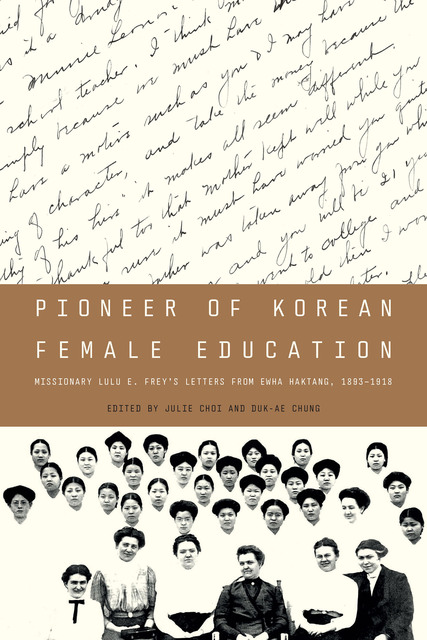
Table of Contents
Metadata
- container titlePioneer of Korean Female Education: Missionary Lulu E. Frey's Letters from Ewha Haktang, 1893–1918
- isbn978-1-64336-661-6
- publisherUniversity of South Carolina Press
- publisher placeColumbia, SC
- restrictionsThe text of this book is licensed under a Creative Commons Attribution Non-Commercial No Derivatives 4.0. International (CC BY-NC-ND 4.0) license: https://creativecommons.org/licenses/by-nc-nd/4.0/
- rights
© 2026 by National Taiwan University and University of South Carolina
The inclusion of this book in the Open Carolina collection is made possible by the generous funding of the University of South Carolina Libraries and Ewha Womans University.
- rights holderNational Taiwan University and University of South Carolina
- series titleEast-West Encounters in Literature and Cultural Studies
- doi